Older Santa Barbara roofs tend to hide a leak until the first big storm of the season. One wet November night there's a brown ring on the hallway ceiling, and by morning a stockpot on the floor is catching the drip.
Here's how a good roofer tracks that water down. They start inside, follow the trail up through the attic, then confirm the entry point on the roof with a close look at the tile and flashing. If that doesn't settle it, they run a controlled water test or bring out moisture tools. A careful roofer won't repair anything until they've found the source.
That order saves homeowners a lot of money. Water almost never drips straight down from where it got in, so a patch over the stain often misses the problem completely. If you're looking into roof repair in Santa Barbara, knowing how the diagnosis works helps you spot a rushed inspection and keeps you from paying twice for the same leak.
TL;DR Quick Answers
Roof Repair Santa Barbara
Good roof repair in Santa Barbara starts with finding where the water gets in, which is often several feet from the ceiling stain.
Find the source first. A careful roofer traces the leak from the attic up and confirms it with a water test before repairing anything.
Look under the tile. On older Santa Barbara clay tile roofs, worn underlayment causes many leaks while the tile still looks fine.
Repair or replace? If the roof is under 15 years old and the damage is limited to one area, a repair is usually the best option.
Get it in writing. Ask for photos of the damage and a written, itemized scope before work begins.
Local help: Quality Roofing of Santa Barbara has handled roof repair across Santa Barbara County since 1996 and offers free roof estimates.
How do roofers find a roof leak? They trace the water from the ceiling stain up through the attic, inspect the roof and flashing, and confirm the source with a water test or moisture tools.
Why isn't the leak above the stain? Water travels along underlayment, decking and rafters before dripping, so the entry point often sits several feet uphill.
Where do most roof leaks start? At flashing around chimneys, skylights, valleys, vents and other roof penetrations.
Why do Santa Barbara tile roofs leak? The underlayment under the tile wears out first, often while the tile still looks fine.
Is it the roof or the AC? A leak that only appears with rain usually comes from the roof. One that shows up on dry days while the AC runs usually comes from the condensate system.
Top Takeaways
The stain is rarely under the leak, since water runs along underlayment and framing before it drips.
A solid diagnosis moves from the ceiling to the attic to the roof, then confirms the source with a water test or moisture tools.
On Santa Barbara's older clay tile roofs, worn underlayment causes plenty of leaks while the tile itself looks fine.
If the drip only shows up while the AC runs, have someone check the HVAC condensate line before you call a roofer.
Why Doesn't a Roof Leak Start Right Above the Stain?
Water moves before it drips. A roof system is a stack of layers. The tile, shingle or membrane on top sheds most of the rain, and the underlayment beneath it does the waterproofing. Wood decking and framing sit under both. Once water slips past the top layer, it follows whatever slope it finds, often running down the underlayment or along a rafter for several feet before it soaks through the drywall.
So a stain next to an interior wall can start at flashing four feet uphill. A drip over the kitchen sink might trace back to a vent pipe near the ridge. Patching the wet spot treats a symptom, while finding the entry point is what stops the leak.
How Santa Barbara Roofers Find a Roof Leak, Step by Step
Every roofer has their own habits, but a careful diagnosis follows the same basic order, and each step narrows the search.
Ask when it leaks. A roofer wants to know whether it drips in every rain, only when wind drives the storm in from one direction, or only after a long soaking. Each answer points somewhere different.
Read the ceiling. The stain's shape and position tell the roofer how far the water likely traveled. Nearby walls, light fixtures and bath fans add more clues.
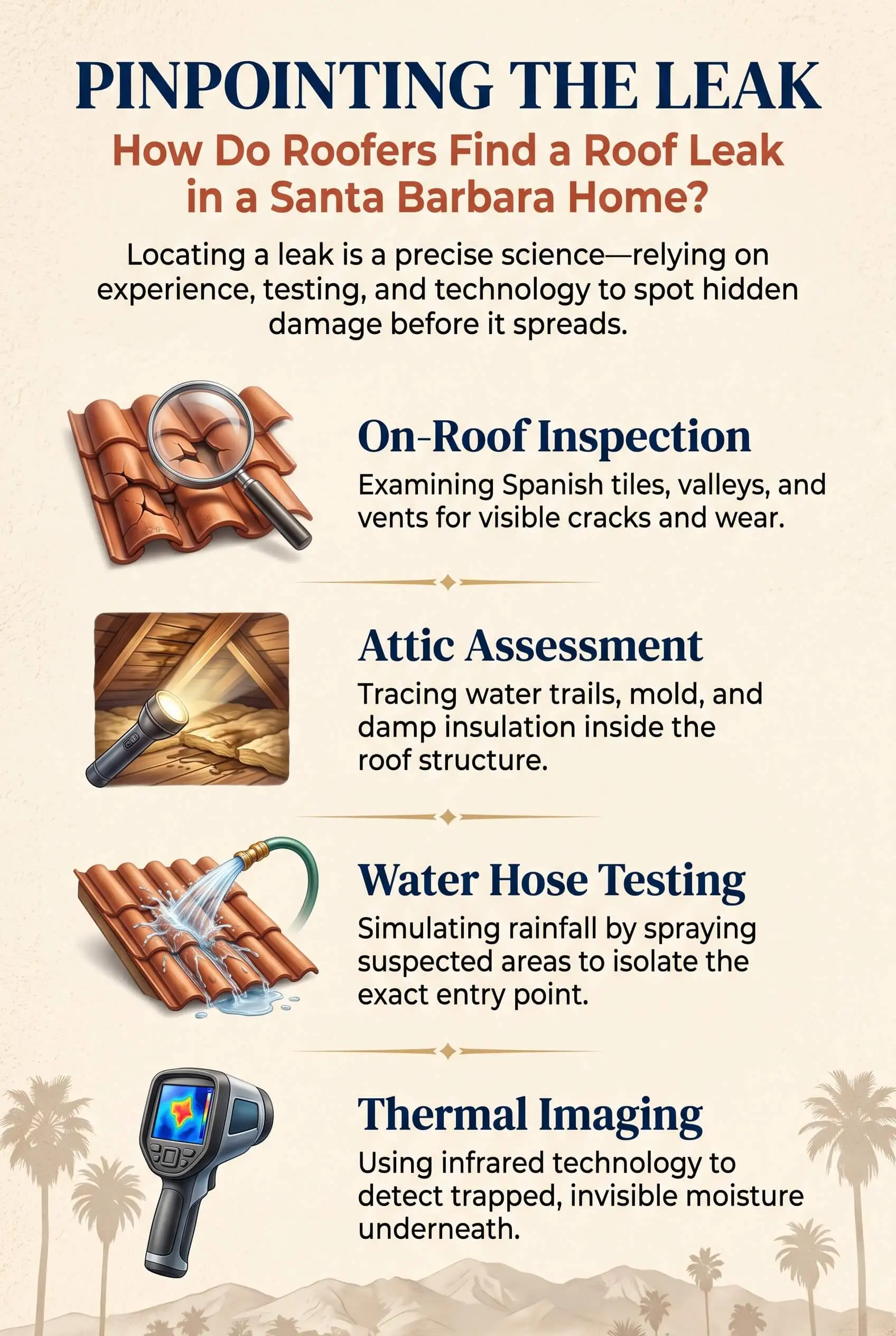
Get into the attic. With a flashlight, the roofer follows the water uphill along the underside of the decking. Darkened wood and rusty nail tips mark the path.
Look at the roof by material. On tile, the roofer checks for cracked, slipped or missing pieces. On shingles they look for lifted or torn tabs. On flat roofs they check seams, blisters and spots where water sits after a storm.
Check the flashing and every penetration. Flashing is the metal or membrane that seals the joint wherever the roof meets something else. Most leaks begin at chimneys, skylights, valleys, wall transitions, plumbing vents and HVAC flues.
Water test it. If the source still isn't obvious, the roofer runs a garden hose over one small section at a time, starting low and working up, while a helper watches inside. When the drip shows up, the last section they soaked is the culprit.
Bring in moisture tools if the roof needs them. Moisture meters and infrared cameras can find trapped water under flat and low-slope roofs without cutting them open. A good roofer still confirms by hand what the camera shows.
Photograph it and write it up. Before any work starts, you should get photos of the damage and the entry point, plus a written plan for the fix.
Santa Barbara Roofs and Weather Make Leaks Harder to Trace
Older Santa Barbara tile roofs often look sound from the street. That's exactly what makes them tricky. On the Spanish Colonial Revival homes downtown and up on the Riviera, clay tile sheds most of the rain while the underlayment underneath keeps the house dry, and underlayment wears out long before tile does. When it fails, the roof leaks with every tile still sitting perfectly in place.
The weather doesn't help. Most of our rain falls in a few winter months, so a small failure can sit quietly through a long, dry summer and then show up all at once in the first big storm. Wind-driven rain pushes water sideways under tile and flashing that would handle a gentle shower just fine. Near the beach, salt air slowly eats away at metal flashing and fasteners too.
Is It a Roof Leak or an HVAC Leak?
Sometimes the roof isn't the problem at all. Plenty of Santa Barbara homes have an air handler or ductwork in the attic, and a clogged condensate line, a cracked drain pan or sweating ducts can all drip onto the ceiling below. If you're not sure what's up there, this rundown of the parts of your HVAC system is a good place to start.
Timing usually gives it away. If the stain only grows when it rains, look at the roof. If it shows up on a dry afternoon while the AC is running, the HVAC system is the more likely source. Either way, don't let attic moisture sit. Damp insulation and ductwork make an easy home for mold growth around AC equipment.
From Diagnosis to Repair
Once the roofer confirms the source, the fix usually gets smaller. A contractor offering roof repair in Santa Barbara can quote exactly what's needed, whether that's one cracked tile and the underlayment beneath it or a flashing joint that's pulled loose, instead of guessing at the wet spot. If the attic shows worn underlayment across a whole slope, or the roof leaks in several places, honest guidance about a roof replacement is worth more than another patch.
What to Do Before the Roofer Arrives
A few minutes of prep protects your things and speeds up the inspection.
Move furniture, rugs and electronics out of the drip zone, and set a bucket or towels underneath.
If the ceiling is bulging with water, poke a small hole at the lowest point so it drains in one spot instead of spreading.
Take a few photos and note when it started, how hard it was raining and which way the wind blew.
Stay off the roof. Wet tile is slick, and clay tile cracks underfoot, which can turn one leak into several.

"Most of the time, the drip in the hallway isn't where the water got in. On the older tile roofs around town, we keep finding underlayment that's simply worn out under tile that still looks great. Homeowners are usually surprised when we show them the attic photos, and that's exactly why we trace it first. We'd rather spend another hour finding the source than sell someone a repair that fails in the next storm."
7 Essential Resources
Bookmark these if you're dealing with a leak, planning a repair or checking out a roofer.
Wikipedia: Roof. A plain-English overview of roof types, materials and the layers that keep water out.
CSLB Check a License. Look up any California contractor's license status and complaint history before you sign.
EPA: A Brief Guide to Mold, Moisture and Your Home. The EPA explains what to dry, what to throw out and how to clean up after water gets in.
InterNACHI: Roof Flashing. An inspector's guide to what flashing does and how corroded or failing flashing looks.
National Roofing Contractors Association. The roofing industry's main trade group, with technical guidance and a contractor search.
City of Santa Barbara Building Permit Forms and Applications. Start here if a repair turns into a reroof and you need to know what the City requires.
Montecito Water District: Weather and Rainfall Data. Local rainfall history that shows when our wet season tends to peak.
3 Statistics
About 1 in 60 insured homes has a property damage claim caused by water damage or freezing, according to the Insurance Information Institute. Leaks put a lot of homeowners on the phone with their insurer.
The EPA says to dry wet materials within 24 to 48 hours to keep mold from growing, per its mold and moisture guide. That's a short window. Finding a leak fast matters as much as fixing it.
Santa Barbara averages about 18.4 inches of rain per water year, according to County of Santa Barbara rainfall records going back to 1900. With that little rain packed into a short season, a small roof failure can hide for months before the first big storm gives it away.
Final Thoughts and Opinion
We think the diagnosis is the most valuable part of any leak repair, and it's also the part roofers rush most often. A dab of sealant over the spot that looks wrong might hold for a season. Then a storm blows in from a different direction, the drip comes back, and whatever damage was hiding underneath has had another year to spread.
Santa Barbara makes that gamble worse. Long dry stretches hide small failures, and a tile roof can look flawless while the underlayment gives out beneath it. A roofer who traces the water from the attic up and tests before cutting into anything is saving you money, even if the visit runs long. Ask for the photos, too.
So when you call around, ask how they'll find the leak before you ask what the fix costs. You'll learn plenty from the answer. This piece on what to look for in a repair company was written about HVAC, including how contractors work with tоp HVAC brands, but most of it holds for roofers too.
Frequently Asked Questions
Why isn't the leak directly above the water stain?
Water that gets past the roof covering usually runs along the underlayment, decking or a rafter before it comes through the ceiling. The entry point can sit several feet uphill from the stain. That's why roofers follow the trail in the attic before they decide where to repair.
Can a roofer find a leak when it isn't raining?
Yes, and roofers trace most leaks on dry days. They read the attic for water trails, inspect the flashing and roofing material, and run a controlled hose test when they need to. On flat or low-slope roofs, moisture meters and thermal cameras can also spot trapped water.
How does a roof water test work?
The roofer soaks one small section of the roof with a garden hose, starting at the lowest point and working upward, while a helper watches inside. When the drip appears, the section they just soaked is the likely entry point.
Why does my tile roof leak when the tiles look fine?
The tile sheds most of the water, but the underlayment beneath it keeps the house dry. Once that underlayment ages, cracks or tears, water reaches the decking even though the tile on top looks perfect from the ground.
How can I tell if it's a roof leak or an AC leak?
Watch when it happens. A leak that appears only during or after rain usually points to the roof. One that shows up on dry days while the air conditioning runs usually points to an attic air handler, a clogged condensate line or sweating ductwork.
Should I repair the leak or replace the roof?
That depends on what the diagnosis turns up. Quality Roofing uses a simple rule of thumb that works as a starting point. If the roof is under 15 years old and the damage is limited to one area, a repair is usually the best option. Widespread underlayment wear or leaks in several spots can make a partial reroof or replacement the better value.
Get the Leak Traced Before It Spreads
Noticed a new stain or a damp spot in the attic? The next storm will only make it bigger. Quality Roofing of Santa Barbara is a family-owned roofer that has handled roof repair in Santa Barbara since 1996. The team finds the source first, then walks you through a written, itemized scope before any work begins. Call (805) 965-2416 to set up a free roof estimate.