TL;DR Quick Answers
top HVAC system repair near Clermont FL
In our experience, "top" HVAC system repair in Clermont comes down to verifiable Florida DBPR licensing, a stocked truck on every dispatch (capacitors and refrigerants on board before the call comes in), and same-day coverage of all three Clermont ZIPs (34711, 34714, 34715). We also tell homeowners straight when a call can wait until morning.
Top Takeaways
Heat waves expose existing wear. Capacitors, contactors, and marginal refrigerant charges fail under continuous load.
Four failures dominate Clermont heat-wave calls: capacitor failure, refrigerant undercharge, frozen evaporator coil, and contactor faults.
Florida DBPR licensing is public record. Verify any contractor at MyFloridaLicense.com before agreeing to service.
Our service area covers every Clermont ZIP (34711, 34714, 34715) and the Lake County perimeter, with stocked trucks and licensed technicians.
We tell homeowners straight when a call is a true emergency and when it can wait until morning. No urgency manufactured.
Why Clermont Heat Waves Break HVAC Systems Faster
In our experience servicing Clermont through summer, there's a real difference between hot and heat-wave hot. A normal Florida day pushes outdoor highs into the low 90s with overnight lows that drop into the mid-70s. Your system runs hard during the day, then gets a recovery window after sundown. A heat wave breaks that pattern. Outdoor highs hit 95 to 100°F, overnight lows stay above 75°F, and the equipment never catches its breath. That’s when a professional HVAC repair service becomes especially important for keeping systems running safely, efficiently, and reliably through extended periods of extreme heat.
That compounds in a Clermont attic. Attic temperatures climb past 130°F and often touch 140°F, which means the air handler and any ductwork running through that space are working in an oven. Duke Energy's grid runs near peak load through the late-afternoon window, and the small voltage drops that come with peak demand stress an aging compressor on startup. Add Chain of Lakes humidity, and the evaporator coil works harder than it should — especially in homes built before energy code revisions tightened envelope sealing.
What we see in the field is straightforward. Components that would last another two or three seasons under normal load fail within a single bad week. Capacitors are the most common casualty, followed by contactors, refrigerant leaks that finally show themselves at full demand, and frozen evaporator coils on systems that were already running marginal. For the technical foundation behind all of this, the Wikipedia HVAC overview is a useful starting point.
Top HVAC System Repair Near Clermont FL: What Top Actually Means
When homeowners search for top HVAC system repair near Clermont FL during a heat wave, they're looking for one of two things. Someone who picks up the phone right now, or someone who can be at the door inside an hour with the right parts. Marketing language about being the best or the fastest is cheap. The signals that actually matter are public record.
Florida licenses HVAC contractors through the Department of Business and Professional Regulation. Every Class A or Class B air-conditioning contractor in the state has a license number that anyone can look up at MyFloridaLicense.com. We invite homeowners to verify ours, and every competitor's, before agreeing to service. NATE certification (North American Technician Excellence) is the technician-level credential. Florida law doesn't require it, but it's a meaningful signal that the person crawling into your attic knows refrigerant charge, electrical safety, and airflow diagnostics.
Top in our book means the truck is stocked before the call comes in. We carry capacitors, contactors, common refrigerants, and standard breaker amperages on every emergency truck. That same preparation is what homeowners expect from a company experienced with every top HVAC brand commonly installed across Central Florida homes. It also means honest dispatch. We'll tell you when a call is and isn't warranted, and we won't pressure a same-day visit on a system that's running marginal but not down. Our service area covers every Clermont ZIP (34711, 34714, 34715) and the Lake County perimeter, including the master-planned communities along US-27 and the older downtown grid south of Highway 50.
The 4 Most Common Heat-Wave Emergency Calls We Run
These are the four failures we see most often during Clermont heat advisories, in order of frequency:
Capacitor failure. The capacitor is a small cylindrical part that gives the compressor and outdoor fan motor the electrical kick they need to start. Heat shortens its life. When it fails, the outdoor unit hums but the fan doesn't spin, or the compressor tries to start and trips the breaker. It's the most common heat-wave call we run, and usually the fastest fix once we're on-site.
Refrigerant undercharge or active leak. A system that was marginal in May shows itself in July. The first sign is air coming from the vents that's cooler than room temperature but never quite gets you to setpoint, followed by ice forming on the suction line at the air handler. EPA Section 608 regulates refrigerant work, and homeowners shouldn't attempt it themselves. Call a licensed technician.
Frozen evaporator coil. This one is often a downstream symptom of refrigerant undercharge or a clogged filter restricting airflow. The coil ices over, the system stops cooling, and water drips from the air handler. On arrival, we shut the system off, let the coil thaw fully, find the root cause, and correct it before restarting.
Contactor or electrical fault. The contactor is the relay that energizes the outdoor unit when the thermostat calls for cooling. Heat, voltage swings during peak demand, and Florida's humidity all chip away at it. When it fails, the outdoor unit doesn't engage at all. Diagnosis takes a few minutes for a licensed technician, and replacement is straightforward.
What to Do Before We Arrive (And What Not to Do)
A few things help while you wait for the truck. A few things make it worse.
Do
Turn the system off at the thermostat if you see ice on the air handler or copper lines. Running a frozen system damages the compressor.
Move infants, elderly family members, and anyone with cardiovascular conditions to the coolest room in the house, typically an interior room on the lower floor.
Open the access path to the outdoor unit. Move yard furniture, trash bins, or anything that's grown up against the condenser fins.
Run ceiling fans for direct air movement on people, not on empty rooms.
If conditions feel dangerous, call Lake County 211 or the local cooling-center line for any occupants at risk.
Don't
Pour water on the outdoor coil to cool it down. Mineral residue clogs fins and creates corrosion problems we'll have to address later.
Run the system if you smell burning or hear an electrical clicking that wasn't there yesterday. Shut the system off at the breaker and wait.
Stack ice on registers or duct mouths to cool the air faster. It restricts airflow and can ice the coil.
Set the thermostat lower than normal hoping for faster recovery. Your system runs at the same speed regardless. Lower setpoints just extend run time.
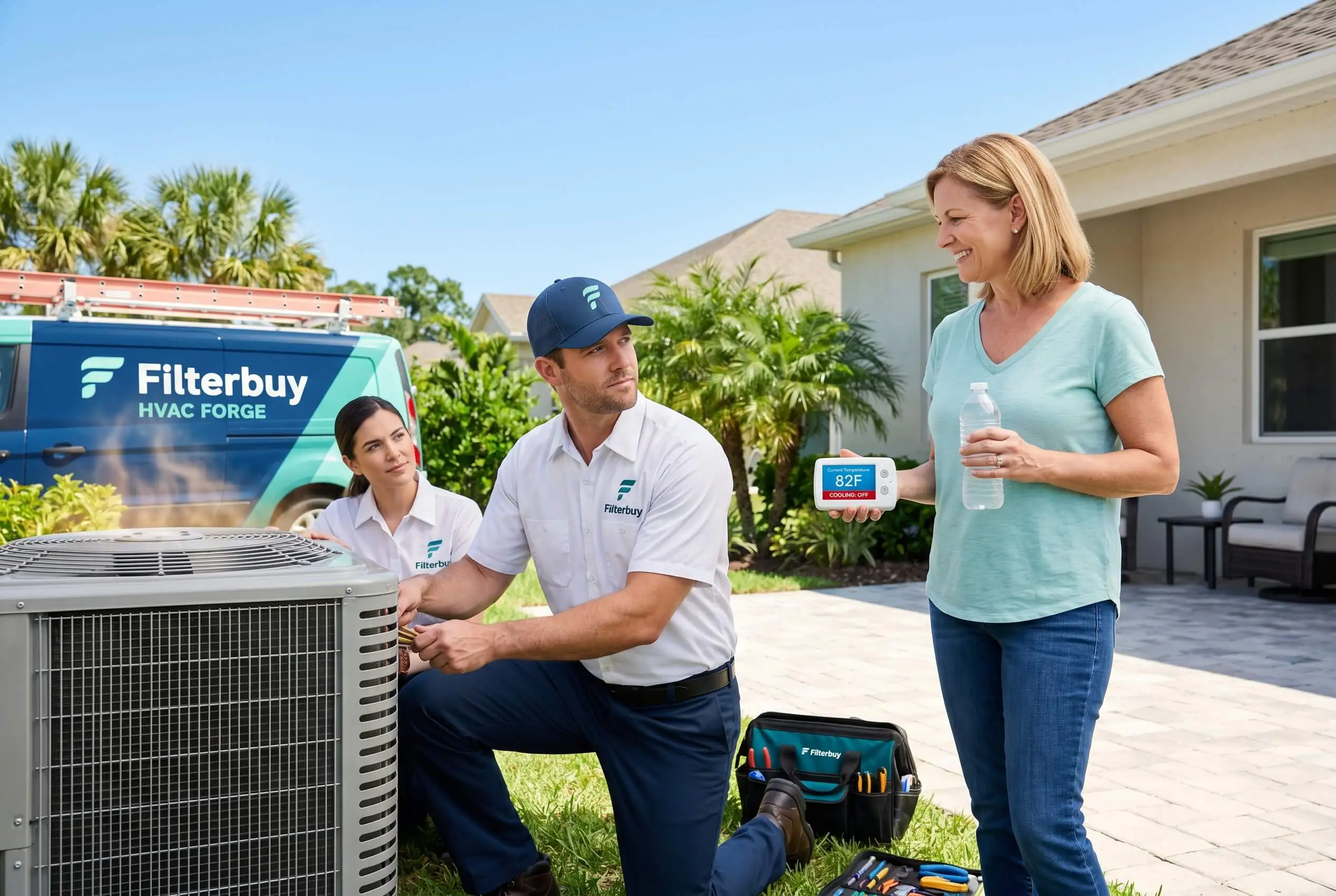
"In my years working HVAC across Lake County, the heat-wave failures cluster on systems eight to twelve years old, especially the units installed during the 1998–2008 build-out across Kings Ridge and Heritage Hills. The capacitor is the canary. When outdoor temperatures hold above 95 with overnight lows above 75, capacitors that read fine on a normal day fall outside spec, and the compressor stops getting the start signal it needs. We carry the common values on every truck for that reason. Most heat-wave calls are a 20-minute fix once we're on-site."
7 Essential Resources
Verify any HVAC contractor, learn the basics of how your system works, and stay ahead of heat-wave risk with these primary sources:
Heating, Ventilation, and Air Conditioning – Wikipedia. https://en.wikipedia.org/wiki/Heating,_ventilation,_and_air_conditioning
Florida DBPR Contractor License Search – MyFloridaLicense.com. https://www.myfloridalicense.com/wl11.asp
ENERGY STAR – Heating and Cooling Maintenance Checklist. https://www.energystar.gov/saveathome/heating-cooling/maintenance-checklist
U.S. Department of Energy – Common Air Conditioner Problems. https://www.energy.gov/energysaver/common-air-conditioner-problems
CDC – Extreme Heat Guidance. https://www.cdc.gov/disasters/extremeheat/index.html
Lake County, Florida – Official Government Site. https://www.lakecountyfl.gov/
National Weather Service – Heat Safety. https://www.weather.gov/safety/heat
These trusted resources help homeowners choose a top HVAC system repair provider by offering reliable guidance on HVAC maintenance, contractor license verification, common air conditioner problems, heat-wave safety, and preventative care that supports faster repairs, safer operation, and dependable cooling performance during Florida’s extreme summer conditions.
3 Statistics
Florida households spend close to three times the national average on AC.
According to the EIA's 2020 Residential Energy Consumption Survey, air conditioning accounts for 28% of total site energy in Florida homes, compared with 9% nationally. In our experience servicing Clermont, that ratio shows up in real time on heat-wave days, when the equipment runs nearly without pause.
Source: U.S. Energy Information Administration, 2020 RECS — https://www.eia.gov/pressroom/releases/press535.php
CDC tracked 119,605 heat-related ER visits in 2023, with 92% in the May–September window.
The CDC's Morbidity and Mortality Weekly Report (April 18, 2024) recorded that heat-related illness ED visits clustered heavily in the warm-season months. What we see in Clermont matches the same pattern. The same window stresses HVAC equipment to failure, which is why we treat any no-cooling call during a heat advisory as a true emergency.
Source: CDC MMWR, Vol. 73, No. 15 (April 2024) — https://www.cdc.gov/mmwr/volumes/73/wr/pdfs/mm7315a1-H.pdf
HVAC accounts for more than 40% of the typical Florida utility bill.
Per University of Florida IFAS Extension, the heating, ventilation, and air conditioning system is the largest single energy consumer in a Florida home, exceeding 40% of utility cost. We see this directly during a heat wave. A struggling system isn't just uncomfortable. It's burning electricity at peak rates while it fails.
Source: University of Florida IFAS Extension — https://edis.ifas.ufl.edu/publication/FY1026
Final Thoughts
Heat waves don't break Clermont HVAC systems out of nowhere. They expose weak parts. A capacitor that read just inside spec last spring, a refrigerant charge a few ounces low after the last service, or a contactor with pitted contacts that survived another normal summer — these are the parts that give out in a bad week. That’s why homeowners trust the top HVAC repair in Clermont to identify small warning signs early and prevent emergency breakdowns during the hottest part of the year. Here's our honest read after years on these calls. Most heat-wave emergencies could have been preventive maintenance calls in March. We're not going to talk anyone into a same-day dispatch they don't need, and we'll tell a homeowner directly when a system can wait until morning. But when it's 96 outside, 84 inside, and there are kids or grandparents in the house, that's the call to make right now.
Frequently Asked Questions
How fast can a technician get to my Clermont home during a heat wave?
Our standard heat-wave dispatch target is the same business day for true emergencies, and inside the hour for cases with vulnerable occupants or no cooling at outdoor temperatures of 95°F or higher. Across Clermont's three primary ZIPs (34711, 34714, 34715), drive time from our service hub keeps most calls inside a 30 to 45 minute response window.
What does emergency HVAC repair in Clermont cost?
Costs vary based on diagnosis. A capacitor swap is typically the lowest-cost emergency repair, while compressor replacement or refrigerant work falls at the higher end. We provide a written estimate before any work begins, and we don't charge a diagnostic fee on confirmed emergency dispatches.
Why is my AC running but not cooling during the heat advisory?
Three causes account for most of these calls in our experience. A refrigerant undercharge from a slow leak that finally caught up. A frozen evaporator coil, which means the system can't transfer heat anymore. Or a struggling compressor on the verge of capacitor failure. All three need a licensed technician, and running the system longer makes each one worse.
Should I keep running my system if it's not cooling, or shut it off?
Shut it off if you see ice on the lines or air handler, smell burning, or hear new electrical noises. Running a frozen or electrically compromised system causes more damage. If the system is simply struggling but quiet and dry, leaving it on doesn't typically make things worse, though it'll keep running your power bill until we get there.
Do you service all Clermont ZIP codes (34711, 34714, 34715)?
Yes. Our service area covers every Clermont ZIP plus the Lake County perimeter, including the master-planned communities along US-27, the older downtown grid south of Highway 50, and the newer developments toward Minneola, Groveland, and the Sugarloaf Mountain corridor.
How do I check if my HVAC contractor is licensed in Florida?
Visit MyFloridaLicense.com and use the Verify a License search. Florida DBPR licenses HVAC contractors as Class A (unlimited) or Class B (up to 25 tons of cooling) under Chapter 489. The lookup shows license status, expiration, and any disciplinary history. We invite homeowners to verify our license, and every competitor's, before signing anything.
What's the difference between a true emergency and an urgent repair?
A true emergency means no cooling, outdoor temperatures above 95°F, and at-risk occupants in the home (infants, elderly, or anyone with cardiovascular or respiratory conditions). An urgent repair is a system that's running but underperforming. We dispatch the same-day for the first. We'll work with you on a 24-to-48 hour window for the second, and we'll tell you honestly which category your call falls into.
Get an Emergency HVAC Technician on the Way to Your Clermont Home
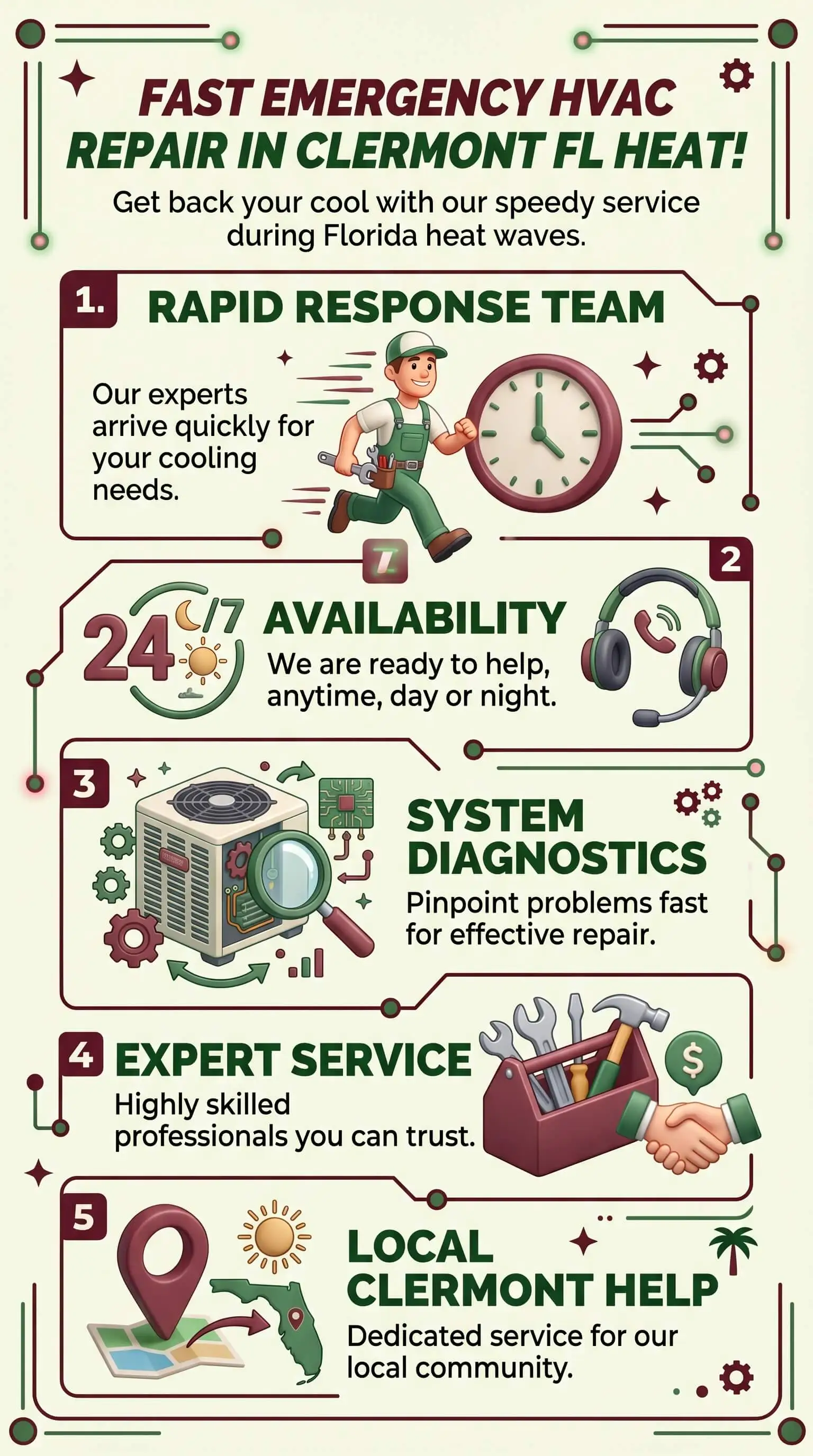
When a heat wave is on and your system is down, our team dispatches licensed technicians the same day across every Clermont ZIP. Homeowners looking for a dependable HVAC repair company can count on fast response times, honest recommendations, and experienced technicians who understand how critical reliable cooling becomes during extreme Florida heat. Call now or request emergency service online. We'll tell you straight whether you need a truck right now or whether the call can wait until morning.
During extreme Florida heat, restricted airflow is one of the fastest ways an HVAC system can become overworked and fail unexpectedly. In Emergency HVAC Repair Near Clermont FL During Heat Waves, we explain how preventative maintenance and proper filter replacement help systems handle the nonstop cooling demands that arrive during prolonged summer temperatures. Using products like 20x24x1 pleated furnace filters, 16x18x1 MERV 8 HVAC air filters, and pleated AC replacement filters helps improve airflow, reduce strain on critical HVAC components, and support more reliable cooling performance during Clermont’s toughest heat-wave conditions.