That musty smell hitting you the moment your AC kicks on isn't just an odor problem. In our years of servicing homes across Altamonte Springs and Seminole County, it's one of the most reliable early warning signs we know — and most homeowners don't recognize it until mold has already established itself somewhere inside their system.
Here's what we've learned from working in Florida homes that most guides won't tell you: Altamonte Springs doesn't just have a humidity problem. It has a sustained humidity problem. The difference matters. A system dealing with occasional moisture can recover. A system cycling through 80%+ humidity day after day — pulling warm, moisture-saturated air across cold evaporator coils for eight to twelve hours at a stretch — never fully dries out between cycles. That's not a maintenance failure. That's Central Florida doing what Central Florida does. And it's exactly why mold prevention here requires a different approach than what works in drier climates.
What this page covers:
Why Altamonte Springs' climate creates mold conditions that most national HVAC guides don't account for.
Where mold develops first inside residential systems — and why those spots are almost always invisible until the problem is serious.
The specific maintenance steps that work in high-humidity environments like ours.
Early warning signs we look for on every service call across Seminole County.
When the problem has moved past DIY — and what to ask any technician before work begins.
We've seen what happens when this problem is caught early and what it costs when it isn't. This page exists so you have the information to make the right call with top HVAC system repair near Altamonte Springs FL before the smell in your vents becomes the mold in your walls.
TL;DR Quick Answers
Top HVAC System Repair Near Altamonte Springs FL
What makes HVAC repair in Altamonte Springs different from anywhere else:
Florida's climate doesn't give your system a break — and neither should your repair provider.
What to look for in a top local HVAC repair company:
Licensed and insured. Verify contractor credentials through the Florida DBPR before anyone enters your home.
Same-day availability. In Altamonte Springs summers, a broken system isn't a convenience problem — it's a health risk.
Local climate knowledge. The best technicians in Seminole County know that Central Florida's sustained heat and humidity create specific failure patterns. Capacitors burn out faster. Drain lines clog more often. Coils accumulate buildup year-round.
Written diagnostics. Any reputable HVAC company provides a written assessment before work begins — no surprises, no pressure.
Transparent pricing. Expect repair costs between $150–$650 for most common issues. Emergency calls during peak summer carry a $75–$150 premium.
Most common HVAC repairs in Altamonte Springs:
Capacitor replacement: $150–$300
Refrigerant recharge: $200–$500
Contactor replacement: $150–$350
Evaporator coil cleaning or repair: $400–$1,500
Blower motor replacement: $300–$700
The one question worth asking any repair company:
Are you fixing what failed — or finding out why it failed?
In our years serving Seminole County, the difference between a one-time repair and a repeat service call almost always comes down to that answer.
Top Takeaways
AC mold in Altamonte Springs is a year-round risk — not a seasonal one. Florida's humidity never gives your system a break. Drain pans, evaporator coils, and air handler interiors face mold-supporting moisture conditions every day of peak season — not just during storm months.
Mold can begin growing within 24–48 hours of standing moisture. A clogged drain line gives mold hours — not days — to establish. Key facts:
A system can cool your home normally and grow mold simultaneously.
No smell does not mean no mold.
Hidden growth is the rule, not the exception.
By the time symptoms appear, exposure has often been ongoing for weeks. The highest-risk household members are:
Young children
Elderly family members
Anyone managing asthma or respiratory conditions year-round
Prevention costs a fraction of what remediation does — every time.
Drain line flush and coil inspection: $150–$200 annually
Ductwork mold remediation: $1,500–$4,000 depending on contamination
The window to act cheaply closes fast in Florida's climate.
Treating mold without fixing the moisture source guarantees it comes back. Before authorizing any mold remediation work, ask one question: are you fixing the source or just the symptom? Any contractor who can't answer that clearly is a contractor worth a second opinion.
Why Altamonte Springs AC Systems Are Especially Vulnerable to Mold
Most mold prevention advice is written for climates that get a break from humidity. Altamonte Springs doesn't get that break.
From what we've seen servicing homes across Seminole County, three conditions make local AC systems uniquely vulnerable:
Sustained humidity. Outdoor humidity regularly exceeds 80% for months at a time — not occasionally, but consistently.
Extended run cycles. Systems running 8–12 hours daily never fully dry out between cycles.
Warm base temperatures. Florida's mild winters mean even "off-season" systems cycle regularly, giving mold year-round opportunity to establish itself.
The result is an environment where mold doesn't need a maintenance failure to take hold. It just needs time.
Where Mold Develops First Inside Your AC System
In our experience across Altamonte Springs homes, mold rarely starts where homeowners think to look. It starts where moisture collects and lingers — and in a Florida AC system, that's almost always one of four places:
Evaporator coils. Cold coil surfaces pulling warm humid air create ideal condensation conditions. Dust and organic debris on coil surfaces give mold exactly what it needs to grow.
Drain pans and drain lines. Standing water in a clogged drain pan is the most common mold origin point we find on service calls. It's also the most preventable.
Air handler and blower components. Dark, rarely inspected, and consistently moist — the air handler interior is where mold can grow undetected longest.
Ductwork. Once mold establishes itself in ducts, it distributes spores throughout every room in the home every time the system runs. This is the outcome every earlier intervention is designed to prevent.
The Warning Signs Most Homeowners Miss
By the time mold is visible inside an AC system, it has almost always been growing for weeks. These are the early signals we look for on every Seminole County service call — and the ones homeowners should know before a problem becomes serious:
A musty or stale odor that appears when the system first kicks on and fades as air circulates.
Visible dark spotting or discoloration around supply vents or return grilles.
Increased allergy symptoms or respiratory irritation among household members — especially in rooms directly below supply vents.
Unexplained spikes in humidity levels inside the home despite normal system operation.
Water stains or moisture around the air handler or indoor unit.
Any one of these signs warrants a professional inspection. Two or more together almost always mean mold is already present somewhere in the system.
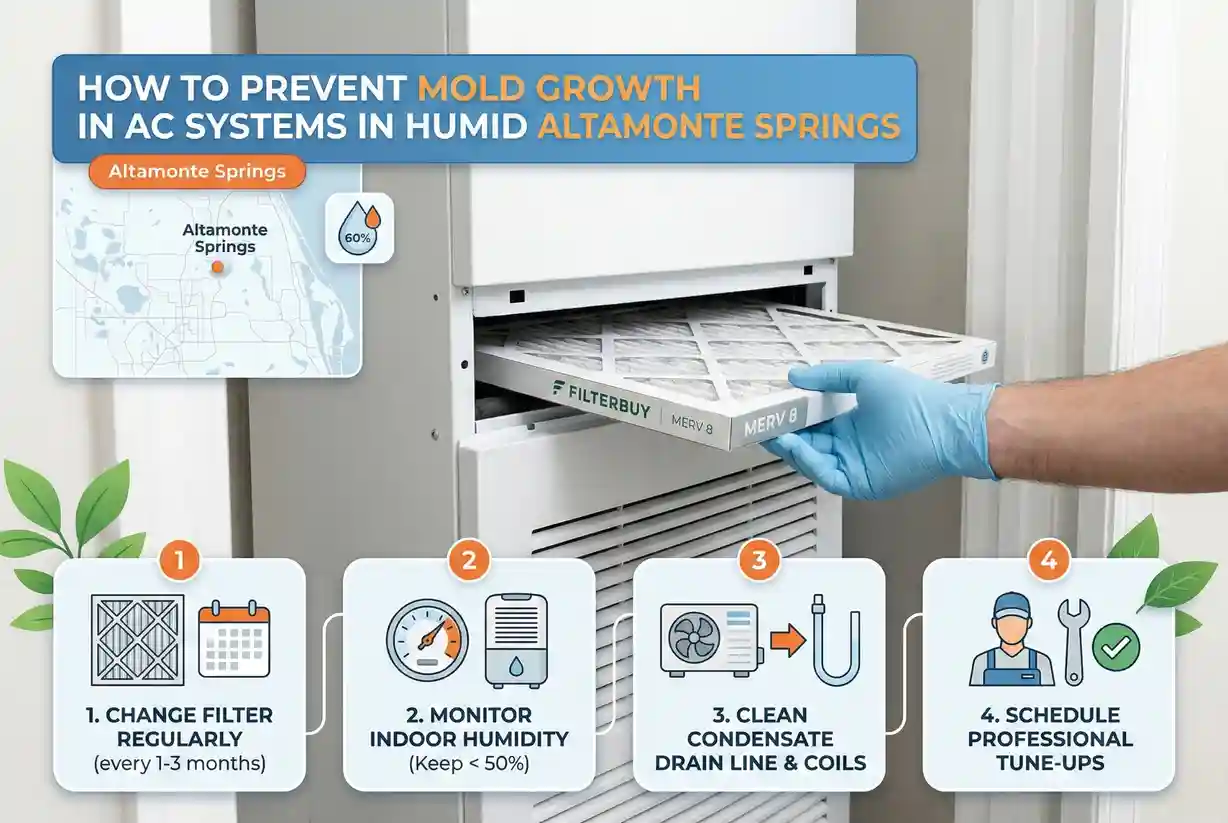
How To Prevent Mold Growth in Your Altamonte Springs AC System
Prevention in a high-humidity environment like ours requires more than occasional filter changes. From what we've found works consistently in Seminole County homes, an effective mold prevention routine covers five areas:
1. Control moisture at the source.
Keep indoor humidity between 45% and 55% using a properly sized AC system and a whole-home dehumidifier if needed.
Inspect and flush your condensate drain line monthly during peak cooling months. A clogged drain line is the single most common cause of standing water — and mold — in Florida AC systems.
2. Keep evaporator coils clean.
Dirty coils hold moisture longer and give mold organic material to grow on.
Schedule professional coil cleaning at least once a year — ideally before peak cooling season in spring.
3. Replace filters on schedule — or more frequently.
In Altamonte Springs, standard filter replacement intervals often aren't enough.
A clogged filter restricts airflow across the evaporator coil, extending the time surfaces stay wet after each cooling cycle.
During peak months, check filters every 30 days.
4. Maintain proper airflow throughout the system.
Closed vents, blocked returns, and undersized ductwork all reduce airflow and extend coil drying time between cycles.
Every room in your home should have both supply and return airflow balanced and unobstructed.
5. Schedule annual professional inspections.
A trained technician inspects drain pans, coils, air handler interiors, and ductwork connections — the areas homeowners almost never see and mold almost always starts.
In Florida's climate, annual isn't a recommendation. From what we've seen across Seminole County, it's the minimum.
When To Call a Professional
Some mold situations move beyond what preventive maintenance can address. Call a licensed HVAC technician when:
The musty odor persists after you've cleaned or replaced filters and flushed the drain line.
You find visible mold growth on or near your air handler, coils, or supply vents.
Household members are experiencing unexplained respiratory symptoms that improve when they leave the home.
Your system is producing more indoor humidity than usual despite normal operation.
What to ask any technician before work begins:
Are you Florida DBPR licensed and EPA Section 608 certified?
Will you provide a written assessment of what you find before recommending any treatment or repair?
Does your mold remediation process address the moisture source — or only the visible mold?
That last question matters most. Treating mold without fixing the moisture condition that created it is one of the most common — and most expensive — mistakes we see in homes across Altamonte Springs. Mold always comes back if the moisture does.
What Proper Prevention Actually Costs — and What Ignoring It Costs More
We share this because most guides don't: mold remediation inside an HVAC system is one of the most expensive service calls we make in Seminole County. Here's the honest cost comparison:
Prevention costs:
Monthly drain line flush: $0 with basic maintenance habit
Annual professional inspection: $75–$150
Coil cleaning: $100–$200 annually
Quality filter replacement: $15–$40 per change
Remediation costs when prevention is skipped:
Drain pan cleaning and treatment: $150–$300
Evaporator coil mold remediation: $400–$700
Air handler interior cleaning and treatment: $300–$600
Ductwork mold remediation: $1,500–$4,000 depending on system size and contamination level
The math is straightforward. A consistent prevention routine costs a fraction of what remediation does — and prevents the health impact that comes with a system actively distributing mold spores through your home every time it runs.
In Altamonte Springs, mold prevention isn't optional maintenance. It's the cost of living in a climate your AC system was never designed to take a break from, and reliable HVAC repairs are what keep your home dry, comfortable, and protected year-round.
"In all my years servicing AC systems across Altamonte Springs and Seminole County, the mold calls that cost homeowners the most are never the ones that started as a mold problem. They started as a clogged drain line nobody flushed, a dirty coil nobody cleaned, or a filter that went three months too long without a change. Florida's humidity doesn't create mold emergencies overnight — it creates them slowly, invisibly, in the parts of your system you never think to look at, until the day your vents smell like a wet basement and your family starts waking up congested every morning. By that point, what would have been a $150 maintenance visit has become a $2,000 remediation call. The homeowners we never hear from again after a mold call — in the best possible way — are the ones who took the prevention conversation seriously the first time we had it. The ones who flush their drain lines, keep their coils clean, and let us look at the parts of their system they can't see once a year. That's not extra effort in a climate like ours. That's just what responsible home ownership looks like when you live somewhere that never gives your AC a real day off."
Essential Resources
We want you walking into every HVAC repair decision with the same confidence our technicians bring to every job. AC breakdowns always seem to happen at the worst times — and the last thing you need at that moment is to discover you hired the wrong company. Whether you're calling us or doing your homework on someone else, these seven resources protect your family, your budget, and your home. Use them every time.
1. Always Verify That Your Technician Is Licensed to Work in Florida
Florida DBPR License Verification Portal Our technicians are fully licensed and insured — and we'd encourage you to verify that about any company you invite into your home, including ours. Florida requires all HVAC contractors to hold an active state license through the DBPR. Hiring someone without one voids your equipment warranty and leaves you with zero legal protection if something goes wrong. https://www.myfloridalicense.com/wl11.asp
2. Confirm Federal Refrigerant Certification Before Anyone Touches Your System
EPA Section 608 Technician Certification Refrigerant handling is federally regulated — not just a technical preference. Anyone servicing, recharging, or repairing refrigerant lines must hold valid EPA Section 608 certification under the Clean Air Act. It's one of the first credentials we verify on our own team, and it should be the first thing you ask any technician before work begins. https://www.epa.gov/section608/section-608-technician-certification-requirements
3. Verify That Any Replacement Equipment Is Certified to Perform as Promised
AHRI Certified Product Directory When a repair requires replacing a major component — a coil, condenser, or compressor — that equipment should carry AHRI-certified performance ratings. From what we've seen across Seminole County, mismatched or uncertified components are one of the most common — and most preventable — causes of voided manufacturer warranties. Check before it goes into your home. https://www.ahridirectory.org
4. Understand the Health Risks of AC Mold Before Authorizing Any Remediation Work
EPA — Mold and Indoor Air Quality in Homes In Altamonte Springs' sustained high-humidity climate, AC mold isn't a rare problem — it's a regular one. We see it in drain pans, on evaporator coils, and inside air handlers more often than most homeowners expect. Before authorizing any mold-related repair or remediation, understand what the EPA says about health impacts, remediation standards, and what responsible contractors are required to address. https://www.epa.gov/mold/mold-and-health
5. Check for Tax Credits and Rebates Before Deciding Between Repair and Replacement
ENERGY STAR Rebate Finder One of the most common conversations we have with Altamonte Springs homeowners is the repair vs. replace decision — and available incentives almost always change the math. Qualifying high-efficiency AC systems can generate up to $600 in federal tax credits. Heat pump installations can qualify for up to $2,000. Check your zip code before finalizing any major component decision. https://www.energystar.gov/rebate-finder
6. Research Ratings and Complaint History Before Scheduling Any Service Call
BBB — Accredited HVAC Contractors Near Altamonte Springs, FL We're proud of our 4.8-star Google rating across 742 reviews — and we understand those reviews are exactly how homeowners should evaluate any HVAC company before opening their door. The BBB's local directory gives you access to accreditation status, complaint histories, and resolution records for contractors serving Seminole County. How a company handles complaints tells you far more than their marketing ever will. https://www.bbb.org/us/fl/altamonte-springs/category/air-conditioning-contractor
7. Know Where to Report a Problem — Before You Ever Need To
Florida Attorney General — Consumer Protection and Complaint Portal Honest assessment and no-pressure advice are commitments we take seriously on every service call. But if you ever experience overcharging, unlicensed work, or incomplete repairs from any HVAC contractor — ours or anyone else's — the Florida Attorney General's Office accepts and investigates consumer complaints statewide. Knowing this resource exists before you hire is your strongest protection as a homeowner. We share it because an informed neighbor is a protected one. https://www.myfloridalegal.com/consumer-protection/consumer-complaint-form
These essential resources help you make smarter repair and replacement decisions by verifying licensing and certifications, checking equipment performance, understanding mold risks, and comparing incentives and complaint history so any work done on Top HVAC brands in America protects your warranty, your home, and your long-term comfort.
Supporting Statistics
After years of service calls across Seminole County, we've learned that mold in an AC system almost never announces itself. It builds quietly — in the parts of your system you can't see — until the day your vents smell wrong or someone in your family starts waking up congested every morning. These federal findings confirm what we've been telling our neighbors for years.
Your AC System Is the First Line of Defense Against the Air Your Family Breathes
Most Altamonte Springs homeowners think of their AC as a cooling appliance. In a climate like ours, it's something more critical than that — it's the primary barrier between your family and the moisture-driven air quality problems that federal research has documented as a serious and underestimated health risk.
What the research confirms:
Americans spend approximately 90% of their time indoors, where concentrations of some pollutants are often 2 to 5 times higher than typical outdoor concentrations US EPA, according to the U.S. Environmental Protection Agency.
In Altamonte Springs, heat and humidity keep families inside for much of the year — making that indoor exposure gap more pronounced than national data alone suggests.
A properly maintained AC system actively controls the moisture conditions that allow mold to establish and spread.
A neglected system doesn't just cool less efficiently. It circulates whatever has taken up residence inside it.
From our years of service calls across Seminole County, the families most affected by indoor mold aren't living in visibly neglected homes. The outside of the unit looks fine. The inside tells a very different story.
Source: U.S. Environmental Protection Agency — Indoor Air Quality https://www.epa.gov/report-environment/indoor-air-quality
Mold Can Establish Itself in Your AC System Faster Than Most Homeowners Expect
Most homeowners assume they'll see or smell a mold problem before it becomes serious. In our experience, that assumption is almost always wrong — and being wrong is measured in repair bills and health symptoms, not just inconvenience.
What the research shows:
If wet or damp materials or areas are dried within 24–48 hours after a leak or spill, in most cases mold will not grow EPA, according to the EPA's Brief Guide to Mold, Moisture and Your Home.
Florida AC systems running 8–12 hours daily expose condensate drain pans, evaporator coils, and air handler components to sustained moisture far beyond that 48-hour threshold — every single day of peak season.
The EPA recommends keeping indoor humidity ideally between 30 and 50 percent relative humidity EPA to prevent mold growth.
In Altamonte Springs, outdoor humidity regularly exceeds 80% for months at a time. Your AC system is the only barrier between that sustained moisture load and your indoor air.
What that means in practice:
A clogged condensate drain line doesn't give mold days to develop. It gives mold hours.
We've found active mold growth in drain pans that hadn't been flushed in a single season.
A system can be cooling your home normally and still be actively growing mold. Most homeowners never hear that until they're already facing a remediation call.
Source: U.S. Environmental Protection Agency — A Brief Guide to Mold, Moisture and Your Home https://www.epa.gov/mold/brief-guide-mold-moisture-and-your-home
AC Mold Is a Family Health Issue — Not Just an HVAC Maintenance Item
When we find mold in a system and tell a homeowner their family has been breathing spores, the response is almost always the same: "But no one seemed sick." That's exactly the part that concerns us most. By the time symptoms appear, the exposure has often been ongoing for weeks.
What the research documents:
Molds produce allergens, irritants, and in some cases potentially toxic substances. Inhaling or touching mold or mold spores may cause allergic reactions in sensitive individuals, and molds can cause asthma attacks in people with asthma who are allergic to mold EPA, according to the EPA.
One third of all structures have damp conditions that may encourage development of pollutants such as mold and bacteria, which can cause allergic reactions — including asthma — and spread infectious diseases US EPA, according to EPA biological pollutant research.
Children, elderly family members, and anyone with existing respiratory conditions are almost always the first to show symptoms.
From what we've seen across Altamonte Springs and Seminole County:
The households most vulnerable to AC mold health impacts consistently include young children, grandparents, and anyone managing asthma or allergies year-round.
Florida's climate never gives their respiratory system a break — which means their AC system can't afford a maintenance break either.
Mold prevention isn't a maintenance upsell. It's a family protection conversation — and we treat it that way on every service call we make.
Source: U.S. Environmental Protection Agency — Mold and Health https://www.epa.gov/mold/mold-and-health
Source: U.S. Environmental Protection Agency — Biological Pollutants' Impact on Indoor Air Quality https://www.epa.gov/indoor-air-quality-iaq/biological-pollutants-impact-indoor-air-quality
In Altamonte Springs, sustained humidity is a year-round reality your AC system manages every single day. When that system isn't maintained, it stops protecting your family and starts working against them. A drain line flush and coil inspection costs a fraction of what remediation does — and protects the people inside your home from an exposure most of them would never know was happening. That's the conversation we'd rather have now than after the fact.
Final Thought
We've walked into a lot of Altamonte Springs homes with a mold call on the work order. In nearly every one of them, the same thing is true: nobody saw it coming. Not because the homeowner was careless. Not because the system was old. Because AC mold in a climate like ours operates entirely out of sight — in drain pans, on coil surfaces, inside air handlers — in the parts of a system most homeowners never see and most maintenance routines never reach.
Here's the perspective we've developed after years of those calls:
Mold in a Florida AC system isn't a sign that something went wrong. It's a sign that something stopped being maintained.
That distinction matters. A system failure feels unpredictable. A maintenance gap is something you can close. In Altamonte Springs — where your AC runs harder, longer, and under more moisture stress than almost any climate in the country — closing that gap isn't optional. It's the cost of protecting your family in a place that never gives your system a real break.
What we'd tell our own neighbors:
The musty smell from your vents isn't just unpleasant. It means mold has already established itself — and every time your AC runs, it's distributing spores through every room in your home.
The absence of a smell doesn't mean you're clear. Some of the worst mold situations we've encountered had no odor at all until we opened the air handler.
A system that's cooling your home is not necessarily a system that's protecting it. In Florida's climate, those are two very different things.
What mold prevention actually comes down to in Altamonte Springs:
Let someone look at the parts of your system you can't see — before symptoms appear.
Flush your condensate drain line every peak season. Not occasionally. Every season.
Schedule a coil inspection and air handler check before summer arrives — not after something smells wrong.
These aren't complicated services. They're the difference between a $150 maintenance call and a $3,000 remediation. More importantly, they're the difference between clean air and compromised air for the people living in your home every day.
We're here when you need us. And if what's on this page helps you need us for the smaller conversation instead of the larger one, that's exactly the outcome we were hoping for.
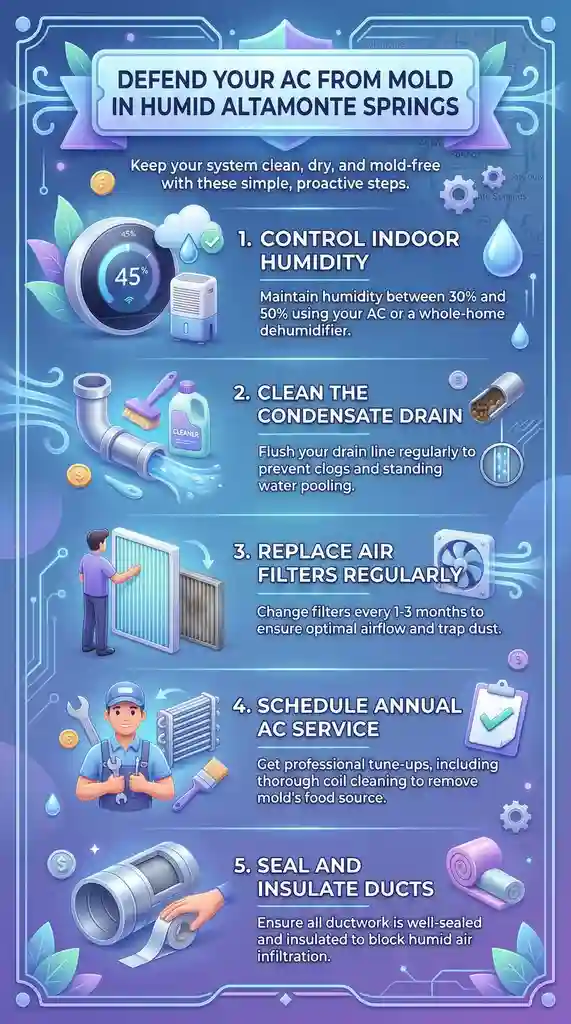
FAQ on How To Prevent Mold Growth in AC Systems in Humid Altamonte Springs
Q: How do I know if my AC system has mold in Altamonte Springs?
A: Most homeowners don't know until the problem is already serious. In our years of service calls across Seminole County, mold rarely introduces itself the way people expect. Watch for these signals:
A musty odor that appears when the system kicks on and fades as air circulates. That timing is the tell — the smell is coming from inside the system.
Visible dark spotting around supply vents, return grilles, or the air handler cabinet.
Allergy symptoms or respiratory irritation that improve when household members leave the home.
Unexplained indoor humidity spikes despite normal system operation.
Water stains or moisture collecting around the indoor unit.
One of these warrants attention. Two or more together almost always means mold has already been present — and distributed through your home — longer than anyone realized.
Q: How does Altamonte Springs' humidity make AC mold worse than other climates?
A: Most national prevention guides aren't written for Florida. Three things make Altamonte Springs fundamentally different:
Sustained moisture load. Outdoor humidity regularly exceeds 80% for months — day after day. Your system never processes dry air.
No recovery window between cycles. Systems running 8–12 hours daily never fully dry out internally. Moisture on coil surfaces from one cycle is still there when the next one starts.
Year-round operation. Florida's mild winters mean most Altamonte Springs systems cycle regularly even in the off-season — giving mold a 12-month window that systems in cooler climates never provide.
From what we've seen across Seminole County: a system in a moderate climate can recover from a missed maintenance season. A system in Altamonte Springs cannot.
Q: How often should I flush my AC condensate drain line in Altamonte Springs?
A: More often than the manufacturer recommends — because that guide wasn't written for Florida. Here's what we tell neighbors across Seminole County:
Flush monthly during active cooling months — May through October at minimum.
Flush once before returning the system to full operation after any reduced-use period.
If your system runs nearly year-round — which most Altamonte Springs systems do — treat monthly flushing as a year-round habit.
Why this matters:
A clogged condensate drain is the single most common mold origin point we find on service calls.
We've found active mold growth in drain pans not flushed in a single season — in systems otherwise cooling the home normally.
A monthly flush costs five minutes and almost nothing. A moldy drain pan costs hundreds to remediate and seeds growth in surrounding components.
Q: Can I remove AC mold myself or do I need a professional in Altamonte Springs?
A: Location matters more than amount. Here's the framework we use when homeowners ask us directly:
Handle it yourself if:
Mold is limited to external vent grilles or return covers — visible, accessible, and clearly contained.
Call a professional when:
The musty odor persists after cleaning filters and flushing the drain line.
Mold is visible on or near the evaporator coil, drain pan, or air handler interior.
Household members consistently feel better outside the home than inside it.
Indoor humidity is rising despite normal system operation.
Before authorizing any remediation work, ask this question: are you fixing the moisture source or just cleaning what's visible? In our years across Seminole County, treating mold without correcting the moisture condition behind it is the single most reliable predictor of a repeat call. The mold always comes back if the water does. Any contractor who can't answer that question directly is worth a second opinion.
Q: What does professional AC mold prevention and remediation cost in Altamonte Springs?
A: Here's the side-by-side comparison we share on almost every mold-related call we make:
Prevention costs — staying ahead of it:
Monthly drain line flush: $0 with a consistent habit
Annual professional inspection: $75–$150
Evaporator coil cleaning: $100–$200 per year
Filter replacement on schedule: $15–$40 per change
Remediation costs — when prevention is skipped:
Drain pan cleaning and treatment: $150–$300
Evaporator coil mold remediation: $400–$700
Air handler interior cleaning and treatment: $300–$600
Ductwork mold remediation: $1,500–$4,000 depending on contamination level
The gap between those two columns is almost always one skipped maintenance season. In Altamonte Springs, that single season has consequences no moderate climate would produce as quickly or as expensively. Prevention isn't just the smarter financial choice. In this climate, it's the only choice that reflects what your system — and your family's indoor air — actually demands.
In How To Prevent Mold Growth in AC Systems in Humid Altamonte Springs, we explain that mold prevention is fundamentally a moisture-control problem, which means your AC has to maintain steady airflow, complete full dehumidification cycles, and stay clean enough to avoid organic buildup on coils and drain pans. One of the simplest ways to support that outcome is consistent filtration with correctly sized filters that don’t restrict airflow, such as a 10x20x1 pleated furnace filter for routine dust control, a higher-capacity 20x20x2 MERV 8 HVAC air filter for systems designed for thicker media, or a properly matched MERV 11 HVAC air filter when you want stronger particle capture without compromising performance. When filtration, airflow, and humidity control are treated as one integrated system, Altamonte Springs homeowners reduce the conditions mold needs to return and keep their AC running cleaner through the longest cooling seasons of the year.