At 7 a.m. on a sticky August morning off Lake Erie, the sensor on your porch flashes orange. The official reading for Buffalo still says yellow.
Don't take that little screen at face value! Home and neighborhood sensors are great at catching the moment the air changes, and much shakier on the exact number unless someone has corrected their data. That gap has consequences. A bad reading can have you scrambling on a perfectly fine day, or leave the windows wide open on a rough one.
I went through EPA's sensor research, New York's monitoring setup, and the field studies on these devices to work out when a reading about air quality in Buffalo NY deserves your trust. My verdict: keep the sensor, and learn its habits.
TL;DR Quick Answers
air quality Buffalo NY
Air quality in Buffalo, NY is usually Good to Moderate, but it shifts fast with summer ozone, Canadian wildfire smoke, and traffic along the Kensington and Scajaquada corridors. For the benchmark reading, check DEC monitors reported through AirNow. Treat home sensors as early alarms, since raw readings run high on humid Lake Erie mornings.
Official source: New York State DEC monitors feed EPA’s AirNow, which reports the city’s official AQI.
Recent grades: The American Lung Association’s State of the Air 2026 gave the Buffalo metro a B for ozone and a C for short-term particle pollution.
Seasonal risks: Ozone builds on hot summer afternoons, and Canadian wildfire smoke drives the region’s worst days.
Sensor caveat: Pick EPA-corrected sensor data, because humidity pushes raw readings high.
Action line: Once the AQI passes 100, close the windows, set the thermostat fan to On, and use a MERV 11 filter if your system accepts one.
Top Takeaways
Low-cost sensors catch changes well and pin down exact numbers less well.
Humid air off Lake Erie is the most common reason a Buffalo sensor reads high.
Choose corrected data every time.
Put every reading through the four-question trust test before you act.
Treat DEC and AirNow readings as the benchmark for Buffalo, and use your sensor as the early alarm that tells you when to look.
Where Buffalo's Official Readings Come From
The number on government maps starts with the New York State Department of Environmental Conservation (DEC). DEC runs the regulatory monitors and sends their data to EPA's AirNow system, which converts pollutant levels into the Air Quality Index on a 0 to 500 scale.
For the current hour, AirNow leans on NowCast, a weighted average that counts the most recent hours more heavily. You get a steady, well-tested number. You also get one that can run a few hours behind a fast change.
What Your Sensor Is Actually Measuring
Here's something that might surprise you: most consumer and community particle sensors never weigh a single speck of pollution. Popular units like PurpleAir pull air past a laser and count the light that particles scatter. From that scattered light, the device estimates how much PM2.5 is floating around you.
EPA classes these devices as supplemental and informational tools, a step below the regulatory network. They still pull their weight in Buffalo. University at Buffalo researchers placed about 30 PurpleAir monitors on Buffalo's East Side at residents' homes to cover gaps the official network leaves.
Why Your Sensor and the Official Number Disagree
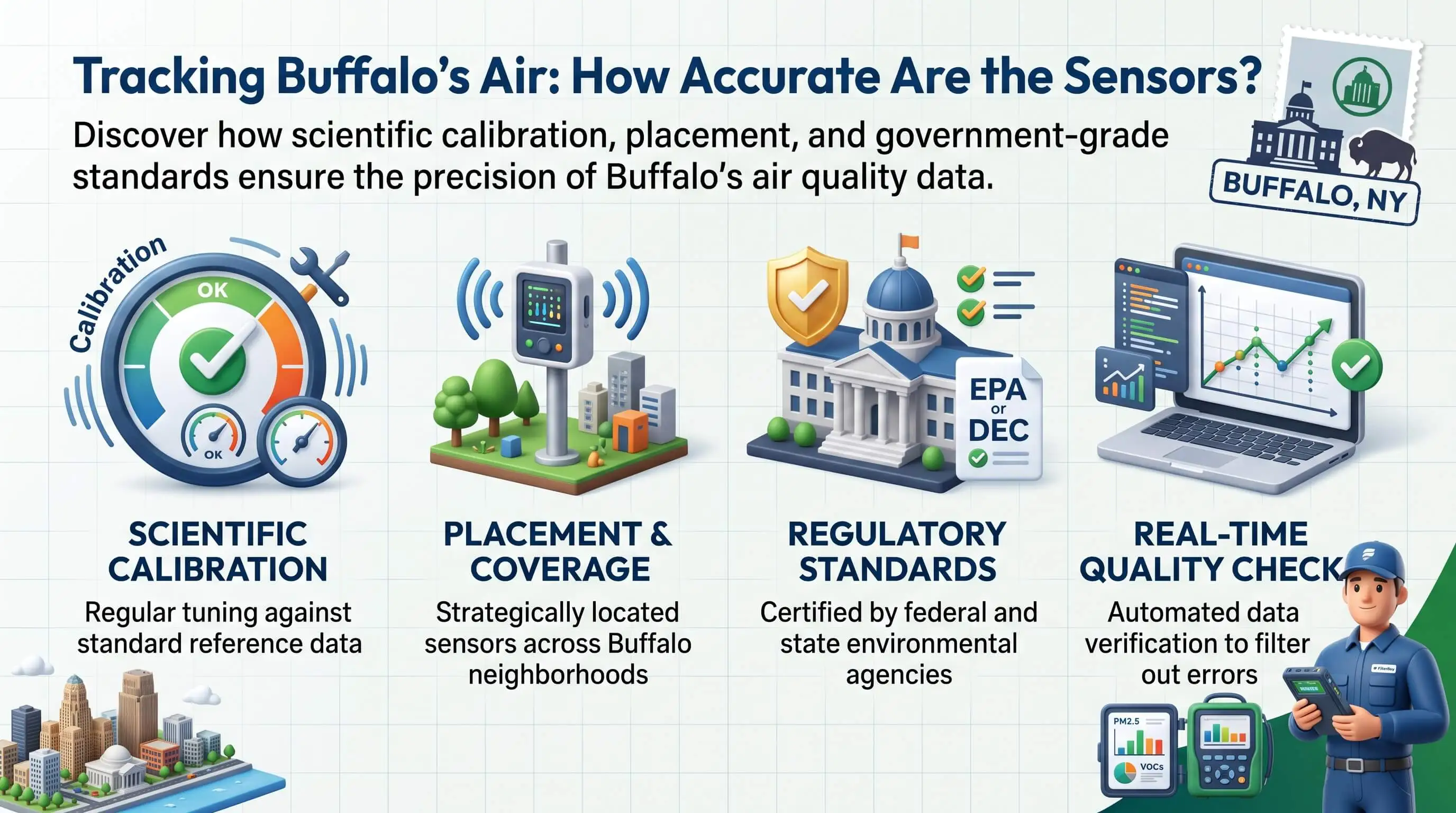
Nearly every mismatch I've looked into traces back to one of four causes.
Humidity off the lake. Damp air makes particles soak up water and swell. The laser reads them as bigger, so an uncorrected sensor runs high on muggy Buffalo mornings while the pollution itself holds steady.
Time windows. Many sensors refresh every couple of minutes, and the official reading averages hours. A truck idling at the curb can spike one and barely nudge the other.
Placement. Mount a sensor beside the Kensington Expressway, a dryer vent, or the grill, and it reports on that one spot instead of your neighborhood. Snow packed against the intake in January throws it off further.
Raw versus corrected data. EPA built a national correction for PurpleAir data that adjusts for humidity, and the AirNow Fire and Smoke Map shows sensor readings with that correction applied. Plenty of apps still show the raw number.
A Four-Question Trust Test for Any Reading
Put any number through these before you act on it.
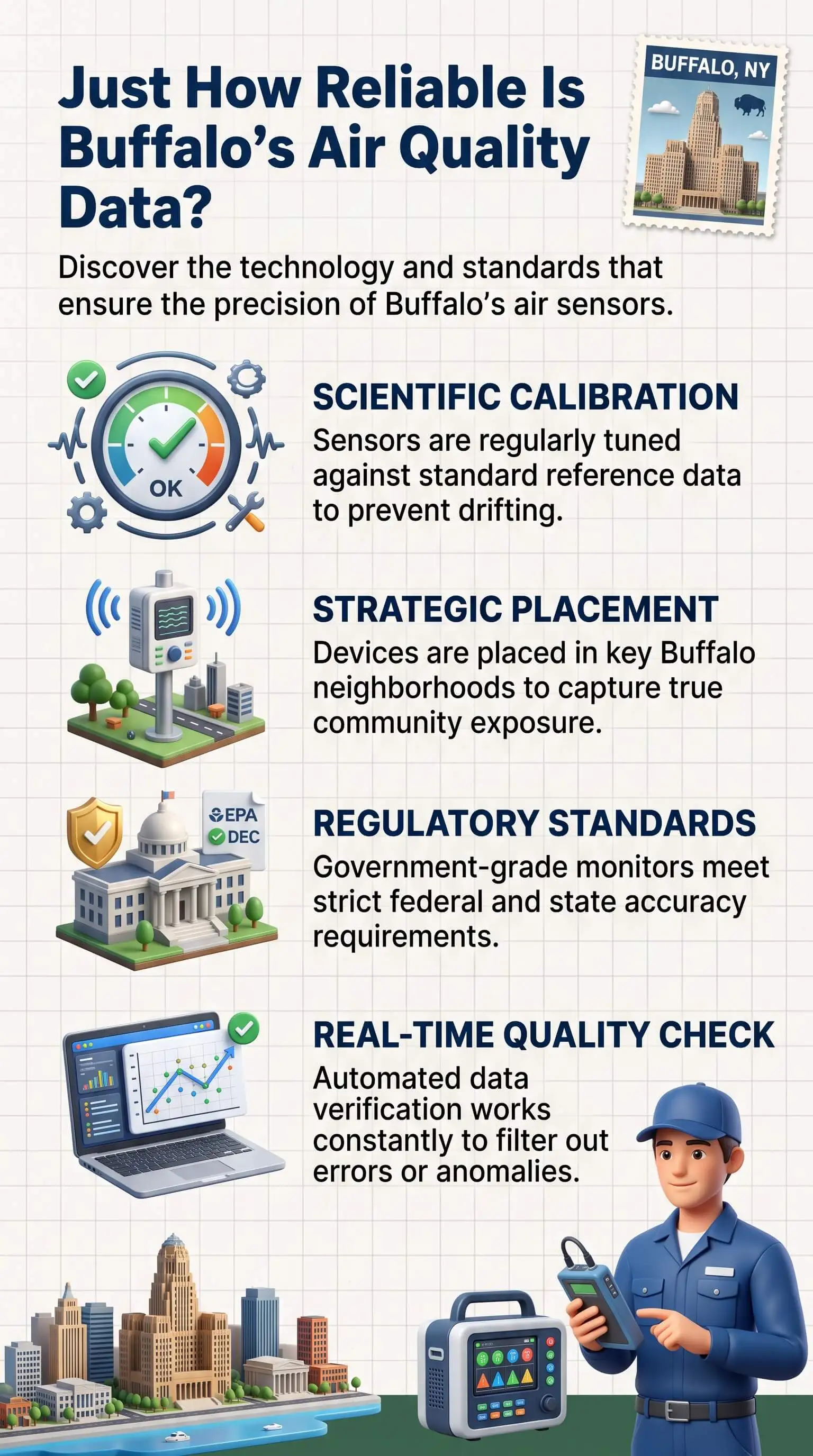
What device took the reading? Look the model up in South Coast AQMD's independent sensor scores, which test devices against reference monitors.
Did anyone correct the data? When a map offers a correction setting, pick the EPA or AirNow option.
Where does the sensor sit? You want open air near head height, clear of vents, roads, and cooking smoke.
What time window does it cover? Compare a one-hour average with the official hourly reading, never a two-minute snapshot.
A reading that clears all four earns my trust as a local signal. Miss two or more, and I treat it as a nudge to go check the official number. Even a system from a top HVAC brand benefits from accurate air quality readings to help homeowners make informed decisions about indoor filtration.
The Side-by-Side Check I Recommend
This quick comparison shows you how far off your own sensor tends to run.
Pick a calm, dry afternoon.
Write down your sensor's one-hour average.
Pull up the nearest DEC monitor in Erie County for that same hour.
Repeat on a humid morning, and again on a smoky day if one rolls in.
After a handful of rounds, you'll know your sensor's quirks, such as running high whenever the air turns damp.
Sensors During Canadian Wildfire Smoke
Smoke days are when a sensor earns its spot on the porch. A plume can roll in faster than the NowCast average catches up, and the sensor down the block shows the climb first. Field testing of EPA's correction found it tracks smoke and winter city pollution closely. That same research caught it reading five to six times too low in desert dust, which Buffalo almost never sees.
Pro Tip: When a corrected sensor jumps on a smoky morning, treat it as your early warning, then confirm the climb on the official map before you make bigger calls.
Checking Air Quality in Buffalo, NY the Right Way
Let your sensor be the alarm and the official network be the benchmark. For the regulatory number, I check a live map built on DEC and AirNow data, listed first in the resources below. It also spells out what each AQI category means for your household.
Once readings pass 100, turn your attention to the air you control. Close the windows. Switch the thermostat fan to On so the system filters around the clock, put in a MERV 13 filter if your system accepts one, and run a portable HEPA cleaner in the bedroom. An air purifier with a HEPA filter helps capture fine particles from wildfire smoke that enter your home. Those steps protect your family no matter which number tipped you off.
"In my years of setting low-cost sensors beside reference monitors, humid mornings fool people more than anything else. Water swells the particles, the laser reads them as bigger, and the number climbs while the actual pollution barely moves. A corrected one-hour average fixes most of that."
7 Essential Resources
Live Air Quality in Buffalo, NY: The city's current AQI from DEC and AirNow monitors, with category guidance and steps for indoors.
EPA Air Sensor Toolbox: Air Sensor Use and Study Design: What EPA says low-cost sensors do well, and how to get good data from them.
AirNow: Using the Air Quality Index: How the daily AQI, forecasts, and current readings fit together.
NYS DEC: AQI Forecast and Current Observations: Daily forecasts for the Western New York region, Erie and Niagara counties included.
EPA's U.S.-Wide Correction for PurpleAir PM2.5 Data (NIH): The study behind the humidity correction on EPA's smoke map.
NOAA Repository: Evaluation of EPA's PurpleAir Correction in Smoke, Dust, and Winter Pollution: Field results on where the correction holds up and where it falls short.
South Coast AQMD AQ-SPEC Sensor Summary: Independent field and lab scores for dozens of particle sensors.
EPA, AirNow, NYS DEC, NOAA, and independent sensor studies provide essential guidance on monitoring Buffalo's air quality, interpreting AQI readings, and understanding sensor accuracy. These resources help homeowners make informed decisions about indoor air filtration, HVAC repair services, and maintaining healthier indoor air.
3 Supporting Statistics
The American Lung Association's State of the Air 2026 gave the Buffalo metro a B for ozone but a C for short-term particle pollution, ranking it 137th worst in the nation for short-term particles. American Lung Association, State of the Air 2026
Researchers writing in 2024 identified relative humidity as the primary source of measurement error in PurpleAir particle sensors, with the effect turning nonlinear at around 50 percent humidity. Atmospheric Measurement Techniques (2024)
A study in CDC's Preventing Chronic Disease flagged 19 Buffalo ZIP codes as asthma emergency departments visit hot spots from 2016 to 2019. CDC, Preventing Chronic Disease (2024)
Buffalo's C grade for short-term particle pollution, humidity-related inaccuracies in air quality sensors, and 19 asthma emergency-visit hot spot ZIP codes highlight the importance of reliable air quality monitoring and using high quality filters to reduce airborne particles and improve indoor air quality.
Final Thoughts and Opinion
Here's where I land. A home sensor makes the invisible visible, and that alone earns it a place in a Buffalo household. It just can't be the referee. The official monitors move slower but hold up to testing, while the sensor reacts fast and bends to humidity and placement.
Put the two together and you get an early warning you can confirm. When someone in your home has asthma, that pairing lets you act with confidence instead of reacting late. A pleated furnace filter with an appropriate MERV rating helps capture airborne particles and supports cleaner indoor air.
Frequently Asked Questions
Is PurpleAir Accurate in Buffalo?
Raw PurpleAir readings run high in humid weather. Apply EPA's correction, though, and they follow official readings closely in smoke and everyday city pollution, which makes them handy for spotting local changes around Buffalo.
Why Does My Air Quality Monitor Read Higher Than AirNow?
Humidity, placement, or timing usually explains it. Your monitor may show raw data, sit next to a local source, or refresh every few minutes while AirNow averages over hours.
Does Humidity Affect Air Quality Sensors?
Yes. Particles absorb water in damp air and grow, so optical sensors overestimate PM2.5. The effect gets stronger once humidity climbs past about 50 percent.
What Is the Most Accurate Air Quality Reading in Buffalo, NY?
Regulatory readings from DEC monitors, reported through AirNow, set the benchmark for air quality in Buffalo, NY. Corrected sensor data makes a good neighborhood-level supplement.
Should I Trust an Indoor Air Quality Monitor?
Trust it for trends, like a spike while you cook or a drop after a filter change. For exact numbers, look up its independent evaluation, and keep it away from the stove and vents.
Trust Your Sensor, Then Confirm It
Let your sensor tell you when Buffalo's air is shifting, and let the official monitors tell you how much it matters. Exploring effective ways to improve indoor air quality, such as better ventilation and air filtration, helps reduce exposure to pollutants that enter your home. Run the side-by-side check on your next humid morning, and you'll know exactly how far to trust the number on your porch.


